Recent Articles
News
In Conversation with Lisa Mahar
Posted by Daylight Books on

Lisa Mahar first started photographing her sons out of necessity. She took her first photograph in this series, a self portrait, when her sons reduced their bunk bed into a heap of splintered wood. It had been ten years since she had picked up her camera, but in that moment, she realized that photography might be the thing that would allow her to survive these trying events with her sons.
Over the past few months, I have corresponded with Mahar. I asked her to write a bit about her photographs for Daylight when I encountered her work at a Mary Ellen Mark workshop in which we were both participants. Although the workshop fell short in terms of intensive critique, Mary Ellen was really engaging in speaking about her own work. The same thing initially drew me to Mahar's photographs--the anecdotes that they both shared when discussing their images were so generative.
Although photographing one's own children is a far cry from dialoguing with individuals who form memory in vastly different cultural settings, Mahar's images often resemble documentary-style photographs of conflicts.
The following text consists of excerpts from our email correspondences.
Kate Levy: Why did you start photographing your sons?
Lisa Mahar: Initially I just wanted to document the challenging events so that I didn't have to internalize them. It was about self-protection, a way to diffuse the stress for me personally. The photographs could hold the tension so that I didn't have to.
Over time though, the images became more of a document of my children's emotional attempts at understanding themselves, me and each other. Ultimately, it allowed me to disconnect from the intensity of the experience so that I could reflect on our relationship rather than constantly react to it.
KL: How has this project informed your parenting?
LM: The process has helped me understand and appreciate that my children are struggling with the same issues I am - how to be part of a family and at the same time separate and independent. I think most parents and children are simultaneously pushing away from each other in order to define themselves as individuals, while pulling together so that they can feel valued and needed. It's a complex interaction that I think plays out in most intimate relationships.
Conflict emerges because we have to reign in our children's eccentricities and inappropriate behavior so that they can succeed in the world and at home. Yes, there can be unpleasant consequences from their acts of independence, but they're rarely disastrous.
My job as a parent is to prepare my children so they can eventually leave us. We connect so that we can eventually disconnect. It's a tenuous balancing act that interests me.
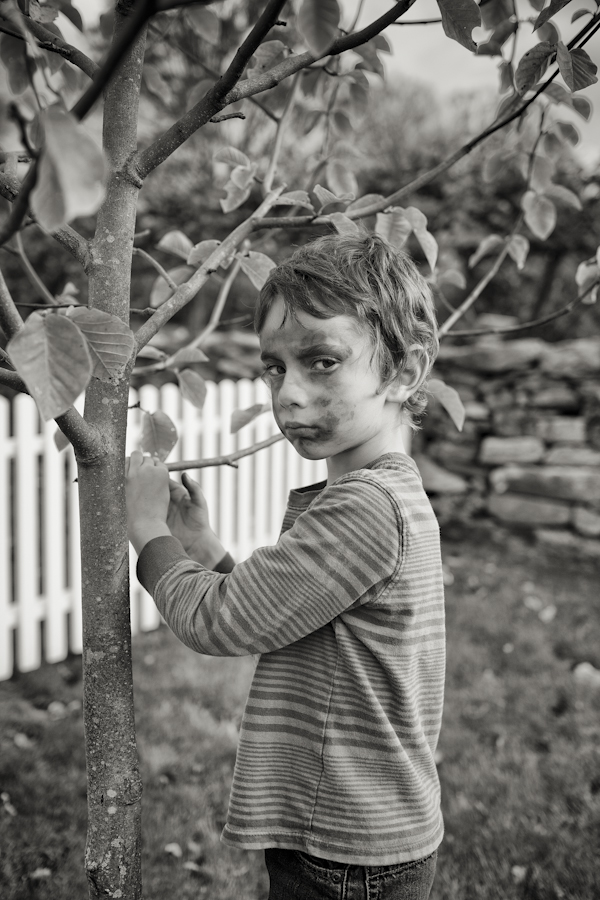
Copyright Lisa Mahar
KL: Is photographing a way for you to take clues from them on what they need?
LM: Children need space to figure out what questions to ask and how to answer them on their own. Taking pictures helps me see that, because it forces me to become an observer.
I've learned that the camera has the ability to restructure an interaction. Occasionally, it brings me closer to my sons by helping us understand each other better, and sometimes it diffuses an emotional event, but it can also be a wall between us. At times it gets in the way of intimacy and dialog and can make everyone feel exposed and uncomfortable.
KL: Your sons inhabit a gaze of seductive challenge in many of the photographs. How were they acculturated to being photographed?
LM: I've photographed them since they were very young, so to a certain extent the camera is just an extension of my arm to them. But there are times when they really don't want me to take a picture, and can get quite upset about it. I haven't lost a camera yet, but there have been some close calls. At other times, they ask me to photograph them or something they've made. It's the same re-occuring theme--one day they push me away, the next they pull me in.
Copyright Lisa Mahar
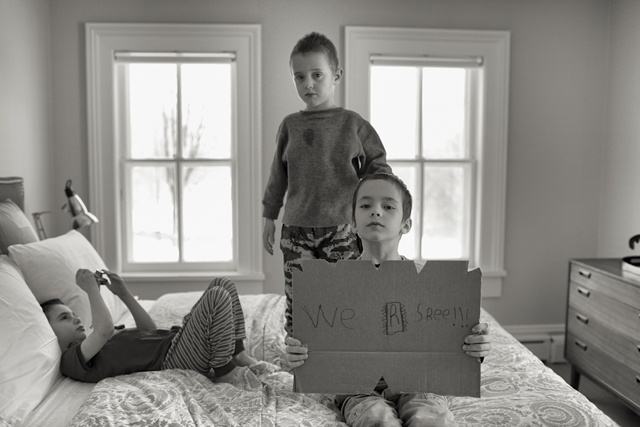
KL: In the "we r sree" photograph, what happened?
LM: You know, I don't remember. I have a pile of "I'm soree" letters and posters from a hundred different infractions. It could have been because they broke something they weren't supposed to touch, or they hurt each other, or tried to force one of the chickens to wear sunglasses.
We find ourselves saying we're sorry to each other often.
Copyright Lisa Mahar
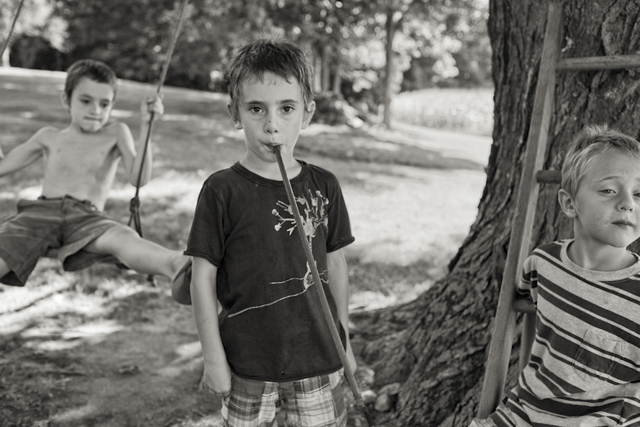
KL: There is one photograph where it appears as though one of your sons is going to be kicked in the back with a stick in his mouth. I am assuming that impending impalement was avoided. Can you recount some of the hairiest circumstances you have encountered with your sons?
LM: Moments like this--where all three children are interacting in dramatic ways happen often, but I'm not always fast enough to catch them. I wish my children were more skilled at using language to resolve conflict, but they often resort to using their bodies instead.
How a child displays emotion is different to how an adult will. It's immediate and transparent. You rarely have to wonder what a child is thinking or how they feel about a situation. It's instantly on their faces and in their gestures. They haven't had the life experiences that makes adults want to hide their feelings. This is admittedly what makes them great subjects. But these emotions are fleeting. What seems like the end of the world to them in one minute is a distant memory the next.
Copyright Lisa Mahar
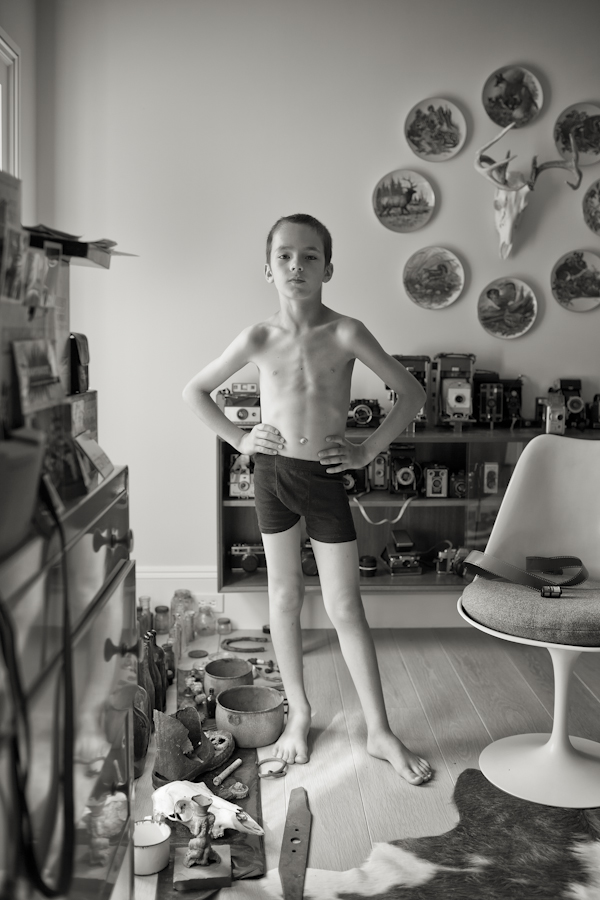
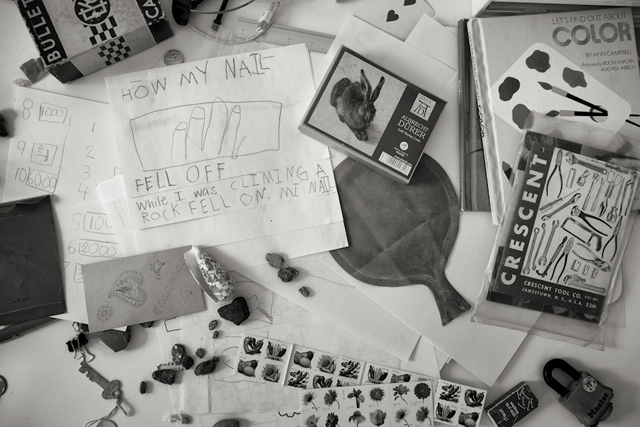
KL: Your oldest son, Emmett, seems to have quite the collection of cameras. Can you tell us about the roll photography plays in his life? What does he say about it?
LM: If you ask him directly why he collects cameras, he says its because they show what's real. Fiction and fantasy have no appeal to him. He doesn't think its possible for a camera to lie.
I think it's partly his way of connecting with me. Earlier this year he saved his money to buy the camera I had as a child--a Minolta SRT101, so he could recreate a double exposed self-portrait I took when I was 12, and then display them side by side in his room. I was very touched by that.
Copyright Lisa Mahar
KL: You also spoke about Emmett's foraging at one point...
LM: All of my children are interested in foraging. It's an activity that makes them feel powerful. They enjoy having knowledge about a subject that most adults aren't familiar with, and they can pretend that they're more self-reliant than they actually are. Emmett also finds it amusing to shock people. Eating earthworms always does the trick.
KL: What are some of your thoughts about how your children approach the process of making things?
LM: Children don't hold onto a fear of being judged that often paralyzes us as adults, and this frees them to produce highly original work. There's no lag between concept and execution. They don't think, "will people will think this is bizarre? Will they think I'm intelligent? Has this been done before? Should I think about this some more before I begin?" They just do it. The process tends to be much more important than the final product for them. The physical outcome is just a document of the journey, a relic of whatever idea they were trying to work through at the time.
My children inform my work in infinite ways. I'm inspired by their process and the questions they ask to guide it. They've helped me see that contradictions and imperfections aren't distractions or things to generate angst, but what makes life interesting and meaningful. They've liberated me from preconceptions and the constraints of perfectionism. It's allowed me to experience life in a far less judgmental way.
KL: Have you identified any questions that your children ask in their artistic processes?
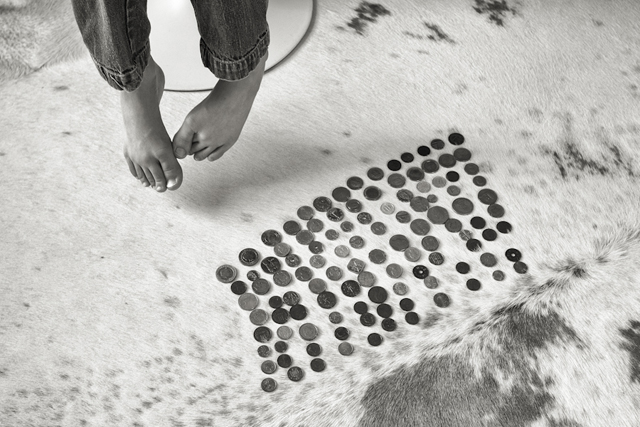
LM: I'm impressed at how often chidrens' questions get right to the essential problems of existence. I admire the way they use whatever skill or tool is accessible to them to get at an answer: words, pens, paper, water, sticks, duct tape, whatever is around them.
One day when Emmett was five he asked me, "how do you make a bad person good?" I said I wasn't sure.
"You show them nice things like how to jump and flip," he said. "If you leave bad people bad, then they teach good people to be bad."
Copyright Lisa Mahar
KL: Are there also aspects of their personalities that affect the way you approach your work?
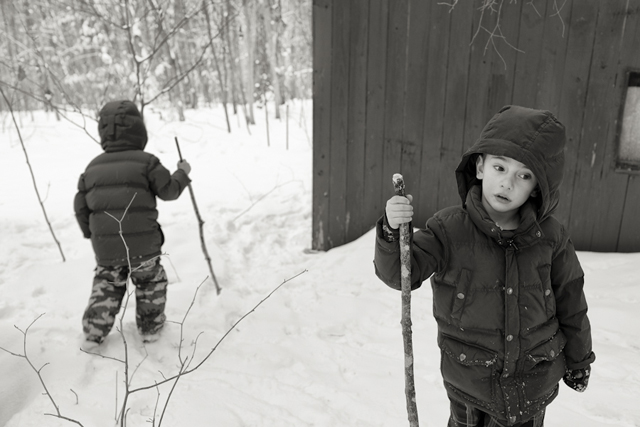
LM: My twins have helped me appreciate what it means to be truly collaborative with another person. They're entirely different people, but aware that they are part of a bigger whole. Until they were four, Eli would say his name was "Eli-Miles," and Miles would say he was "Miles-Eli."
Copyright Lisa Mahar
Spatially, they're constantly relating to each other, either in opposition or integrally connected. So much so that it's difficult to photograph them individually. It's helped me understand that no matter how separate I try to be, every interaction with another person is a collaboration to some extent.
Eli, in particular understands what makes himself and others feel the way they do, and it draws people to him. He has an intuitive sense of what motivates a person just by observing them.
KL: How can you emulate this with your camera?
LM: I've learned a lot from the painter Paul Klee, who was skilled at giving form to forces you can't see.
It's a fascinating challenge to think about how to make the invisible visible. I often wonder how I can reveal the things I perceive, but don't see.
KL: These photographs document a world cut out from any notions of the day to day reality, which seems a bit idealized. References to technology, contemporary modes of transportation, et cetera, are not present. Do you see including these things as a possibility for the work to progress?
LM: Emmett has an aversion to technology, so there's really nothing contemporary in the spaces he inhabits. And oddly, he's never found toys appealing. I don't have the same disdain, and neither do the twins or my husband, but we live in Manhattan, so our time at our farm is a break from that world.
I don't think the landscape is idealized, just rural. It's a place that gives me the opportunity to connect with ideas and at a pace that's better suited for self-reflection. I'm not nostalgic about the past--I welcome technology. But I do enjoy the way time slows here.
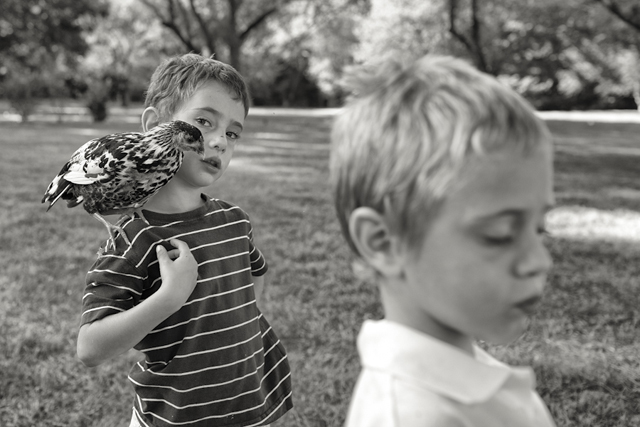
When Emmett was three and didn't want something to end, he would say that he wished the earth would stop spinning so that time would stand still and he could continue whatever it was that he was doing. It's a reminder that everything is connected and that each little thing we do affects the outcome of what comes next. On the one hand, nothing is that important, but on the other, everything is cosmically connected and therefore enormously significant.
Emmett still thinks about everything in relationship to time. He needs a historical framework to ground his ideas. When he was six he began to classify his things by date and period--books, bottles, even his family. He once described his father as a "mid-century modern" because he was born in the 1950s.
Copyright Lisa Mahar
KL: How do you feel that your work differs from Sally Mann's infamous work with her own children?
LM: Other than the fact that we both have boys named Emmett, we photograph our own children, and shoot in black and white, I find the work to be very different. Mann's images are constructed; she has a clear idea about what she's going to end up with before she starts. Shooting with a large format camera necessitates that for her.
There's also an overt sexuality to her images, and a preoccupation about what it means to be a young girl, and how our culture perceives that vulnerable transition to womanhood. The tension in her work comes from one's assumptions about what is being shown vs. what's actually going on.
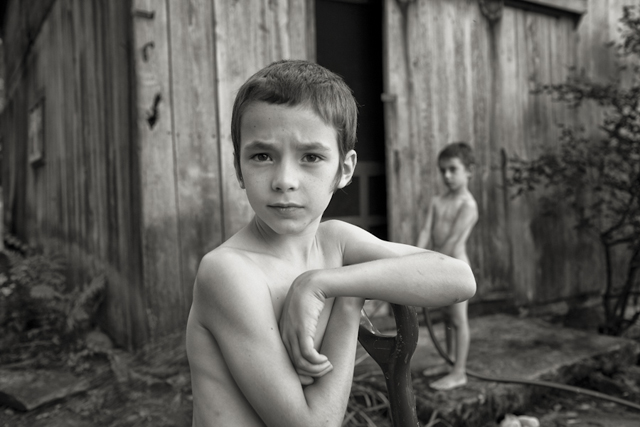
In my work, what you see is what you get. I shoot with a small format and capture moments as they happen. I don't set up shots, I just try to be at the right place at the right time. My children are constantly in motion--both physically and emotionally. Their reactions are raw and sincere.
Ultimately, I hope the work touches on some truths about the complexities and challenges of being responsible for another human being.
Copyright Lisa Mahar
KL: Do you think about how your children will look at these photographs when they are older?
LM: As a parent, I have a responsibility to think about that. Of course my children could say that the images are personal, and that they were not old enough to choose whether they wanted them taken or shown to others, and that would be accurate. But they couldn't say that the photographs were disrespectful or untrue. I hope they see that it was a way to help me better understand them and myself.
To have an honest record of one's childhood is something I've come to appreciate more as the years pass. When memories fade and the people that witnessed our youth disappear, the photographs take on a new significance. They remind you who you were and what you have become.
For me, it would be unsettling not to have a record of myself as a child. I think I'd feel almost as if I never existed. But I don't know if my children will feel the same. I'll have to wait and see.
Alphabet of Light (#14), by Kirsten Rian (Magdalena Sole)
Posted by Daylight Books on

Photograph by Magdalena Sole
Measurement
There are instruments for measuring or examining anything. Selenoscopes view the moon. Serimeters test the quality of silk. Topophones determine the direction and distance of a fog horn. Xanthometers measure the color of sea or lake water. A chromatoptometer measure’s the eyes’ sensitivity to color and I have learned to lean into grey most of the time. With a megameter I could determine longitude by observing stars.
Physicists have discovered in recent years a way to ‘squeeze light’ by combining photons to create a triphoton and state of polarization that then applies itself to highly precise measurement. More accurate than laser beams, quantum light waves have the potential to track and measure small distances or objects still or moving, and its scientific implications are tremendous. In my world, light spilling across my hand or my daughter’s face, dripping off the edges--I can’t grasp or evaluate its signature, and thus it remains an intangible quantifier of dimension, more mood-evoking than a tool of evidence.
I think about photography and its obvious technical scaffolding, but still ever-reliance on the uncalculable documenting of humanism.
“I think good art illuminates something that hovers in the background. A most successful picture surprises, reveals something that was unknown to the viewer before they saw the picture. Nothing tangible...” photographer Magdalena Sole tells me.
She uses the word “witness” both in her artist statement, and also in conversation with me, describing her process as becoming invisible, “just standing somewhere and becoming a witness.”
Perhaps best known for her very moving Mississippi Delta work, a newer project took her to post-tsunami Japan. Curated by Elizabeth Avedon, the photographs show a tiny neighborhood called Kamagasaki in the Nishinari ward in southern Osaka, where 3,000 aging homeless men live in makeshift cardboard huts or flophouses.
“I am always drawn to people, societies that live on the margin. Mainstream bores me. Somehow when I meet communities that are marginalized I feel a kinship and excitement. I feel compelled to show their beauty, their suffering, their resilience. Perhaps they are my heroes. This happened in the Delta, but also in Japan after the great Tsunami struck and people who were leading normal lives were suddenly catapulted to the margins and to an existence where everything past was lost.”
I’ve always found that the most authentic work is rooted somewhere in the story of the artist themselves. The details don’t necessarily need to be known by the audience or even the artist, but they’re evidenced in another one of those intangibles, the layers of dimension simply felt when one looks at a body of work that resonates history and self. Magdalena tells me, “There have been many moments that cracked my world open, each time the crack would become a bit larger. The first one I remember was when my family left from Spain to Switzerland in the middle of the night. I was 6 years old. It left me with a sense of homelessness. That was only the first crack. It taught me about living on the margins.”
As is typical of Sole’s work, the images are honest, and she captures a broad spectrum of what it means to live daily life, homeless or not. She tells me about simply trying to “observe life, as is.”
She continues, “The neighborhood is marred by homelessness, poverty and declining health. Osaka residents shun the area. Kamagasaki’s ecosystem hosts 60 Yakuza syndicates who deal drugs, run gambling and prey on welfare recipients. As forlorn as Kamagasaki might seem, men living in cardboard boxes arrange their shoes as if at a fine inn. Every evening they head to the public bathhouse. Though outcasts, these men project the core values and vitality of a polite, respectful, highly organized Japanese society.”
Tonight my kids and I will go watch the swifts dive into the chimney of a school in northwest Portland. Each night in September an hour before sunset anywhere between 1,700 and 35,000 birds gauge the sky for light and in perfect synchronicity with sun and moon and day and night thread the sky from miles around to their roosting post until morning. Since the 1980s when their natural habitat of old growth Douglas Fir trees diminished, the school is on their migratory route towards Central and South America. I wonder about the light-measuring rulers inside their teency brains and hearts that align to such precision day in, day out, each and every year.
City-dwellers set up picnic blankets and eat sandwiches on the school lawn and watch, all of us, heads turned up to the sky. The dignity of lining up shoes or books on a cardboard floor is not maneuverable by statistics, and neither is the sky. Data of diminishing brightness and color informs of tangible implications of visibility impact, but it cannot explore or implicate the emotional tethers created when one’s head is thrown back and for a second or two, we just look--at each other, or at light, or at birds. In those moments, a day is contained with clouds, or color, or a stippling of the sky by thousands of swifts, with all that remains steadily and constantly there.
To view more of Magdalena Sole’s work, visit: http://www.solepictures.com/
Kevin Kunishi's 'Los Restos de la Revolucion' Launch Party at the Anastasia Gallery
Posted by Daylight Books on

“I wanted to move beyond the broad recital of policy and ideology within the textbooks I read during my undergraduate studies and explore the personal experiences of individuals directly affected by those policies.”
Daylight Books is proud to present Kevin Kunishi's first monograph, 'Los Restos de la Revolucion'. Come celebrate with us at the Anastasia Gallery for a launch party and book signing on Thursday September 27th from 6:30PM to 8:30PM. Kevin Kunishi's photo book brings us into a personal encounter with the scars that were left behind after the civil war between the Sandinistas and the Contras; which tore apart Nicaragua from 1980 to 1990.
Music and drinks will be provided and books will be on sale for the event.
Information and RSVP:
Purchase a Print:
PhotoLucida Portfolio Reviews Registration
Posted by Daylight Books on
Registration for the 2013 PhotoLucida Portfolio Review will open October 2nd for a 48 hour period in which afterwards a lottery will be held assign the lucky participants' review slots for the event. Participants will have their work reviewed by various industry professionals which will provide great opportunities to network, exhibit, publish and sell work. The reviews will once again take place at the Benson Hotel during the Portland Photo Month from April 18-21, 2013.
Information:
http://www.photolucida.org/critique.php?pl=9accb6286287ae4e61c5eec8a4307234
Image by Carrie Mae Weems, PhotoLucida's Great Northwest Portfolio.
Alphabet of Light, #13, by Kirsten Rian (Jon Edwards)
Posted by Daylight Books on

Photograph by Jon Edwards
Harvesting
“I am a product of my times and my life experience. Jimi Hendrix, The Filmore East (attending Woodstock as a 17 year-old), the Anti-War movement, and attending a very liberal college after growing up in a very conservative family and area. Before college, I didn't know what liberalism was. Once I explored modern (1970) photography (Arbus, Friedlander, Winogrand, Krims, etc.), Political Economics/Science, and travelled the country as an undergraduate on a co-op job (ranging from pumping gas, delivering an ‘underground’ community paper in Portland, Oregon, to a prisoners' rights project in Jackson, Mississippi) my course was set, and I've never looked back. After similar experiences in law school, and after practicing civil rights and environmental law, I'm now returning to my rural, photographic roots.
But I carry all I've learned and seen along the way with me to every photo shoot,” Jon Edwards tells me.
---
“Yes, photography is all about light, but when it works, it's also about evoking emotions.”
---
I first met Jon, years ago, at a portfolio review event in San Francisco. He spread black and white images across the table between us of an elderly man in Maine, John Ryan, who sustained himself by harvesting apples and seaweed and working the land. There was nothing flashy or egotistical about these photographs. They were honest and direct. As a photographer, Jon got out of the way and allowed the images to tell their own story. He showed up and shot and trusted in the eloquence of reckoning between the actual and the metaphor, the visible and that beyond the frame.
---
“Like a meaningful poem, it sets off a personal emotion, although it may be a more universal thought or image. Perhaps if a photograph incites a past emotion, the viewer may realize that it is a distant feeling that is no longer felt. For example, I have heard from many viewers that my image, Praying to the Pie Gods, reminds them of their childhood when they would engage in a physical activity with a grandparent, and perhaps like the image, one that they no longer have time for, or can remember the last time they participated in --- like baking a pie from scratch. Do we connect to the image because we feel a loss in our everyday hectic lives, a relief that at least somewhere people still make the time, at considerable ‘expense’ as we define success in our society, or another emotion that we can't put our fingers on, but know on some level we're missing?”
---
I am about seven, my mother is crouched next to me and gently drawing the trowel across the soil to make a trench about a quarter of an inch deep. Her line is straight. She shakes a seed pack into her hand and holds her palm out to me. I remember it is difficult for me to pick up the carrot seeds with my tiny, chubby fingers, I try grabbing them, and she shows me how to pinch, squeezing my thumb and forefinger tightly. Then she takes my wrist and guides it to directly over the indentation she’d made in the dirt and shows me how to now rub my pinched fingers together slowly to release the seeds. They fall like crumbs. I lean over and peer into the ground, my face inches away, I can smell the damp, musty earth, but I cannot see the seeds, they have blended in with the compost, manure, fireplace ash, and topsoil. I am disappointed, I think this is a bust. I can’t be sure the seeds landed where they were supposed to, where I had intended. And on top of that, I can’t comprehend how an entire carrot, with green top and all, can possibly emerge from that teency speck that looks like a caraway from my rye bread toast.
My mother places a popsicle stick straight up like a flagpole at the start of the seed line. When we’ve emptied the packet, she rips a hole at the bottom and pushes it over the stick, marking our row. We skim our hands across the dirt to cover the seeds. My mother tells me to fill up my kid-sized tin watering can, and she shows me how to keep the can moving back and forth like a cello bow so puddles don’t accumulate and drown out the seeds.
Each morning I go out to the backyard and check the garden. I’m worried one day when it rains hard rain, but my mother talks to me about roots and says the seeds have sprouted some by now, so they can hold on to the ground and just drink it all up. I can’t believe it when finally slips of green punctuate the brown.
---
I ask Jon how he got started photographing John.
“John picked apples at an organic farm where we have been members (CSA) for over 20 years. I originally photographed him pruning trees in the winter, and a couple of years later asked if I could accompany him harvesting seaweed...
John very much reminded me of people I had the good fortune of meeting, as a child, in the Adirondack Mountains, where for several generations my family summered. He especially reminded me of my best friend's uncle who had a shop in a log cabin where he whittled birds and worked on antique guns, i.e., mussel-loaders and old Winchesters.”
---
“I've also learned some very practical things from the people I photograph. How to raise and keep chickens without an elaborated setup, organic gardening, how to be more self-sufficient, and a love of the ocean.”
---
“In part, I remain committed to documentary photography because I see a way of life, and not just a distant one on the coast of Maine, that is in jeopardy. It's a natural transition from my practicing environmental law for over 25 years. To me, it's really the same thing, I'm just expressing it in a new medium, one that others outside of the courts and government can see. It's my hope that some people will, rather than just be nostalgic for a vanishing culture, see that we are careening out of control on a total unsustainable path. I constantly hear about vanished fisheries, and have seen hand harvesting of seaweed go by the boards as underwater lawn mowers have taken over. One can only imagine the environmental impact that such mechanized cutting will produce. I stay interested in photography because, while it's capable of many, many things today, it's still capable of showing what we are doing as a society, our environmental and human impacts. Maybe it can't change those, but it can convey the emotional cost of what we are doing and maybe it can, eventually, be part of the reason people act.”
---
It’s a cliche to say the earth doesn’t forget. But there is a single patch of land on the west side of town that my mother has stood on for 45 years. She skirts it most of the time now, the bulk of her days spent in her car; but occasionally she stops running and returns to what she knows, gets her trowel out of the garage, buys some starts, remembers a piece of herself. She bends down, touches the soil, and the soil touches back. It is the only thing left that does.
---
“One last thing I've learned while photographing. There is a lot to be learned from the older generations. I've certainly learned much about life, rural life, what matters in the long run etc. I think we lose much by not having a closer relationship with our elders. John always says to me, "why do you find anything I'm doing of interest? Look around, my life is a wreck, all I have is junk and what can I offer my kids? The answer is so clear to me, and it's why I and some of my most respected contemporaries, the farmer where he used to work, want to be with him. He offers hope that no matter what life throws at us, we can stand up to it and at the same time inspire others to do the same.”
To view more of Jon’s work, visit: http://www.jonedwardsphotographer.com/
To view a multimedia piece by Daylight on Jon, visit: http://daylightbooks.org/news/2011-new-multimedia-jon-edwards